· Diego Martínez Núñez · Industria · 4 min read
A historic opportunity: Argentine grass-fed beef breaks into the United States
The U.S. quadrupled the tariff-rate quota for Argentine beef. To capture the wave, especially with grass-fed, digital traceability is the passport to the world's most demanding market.
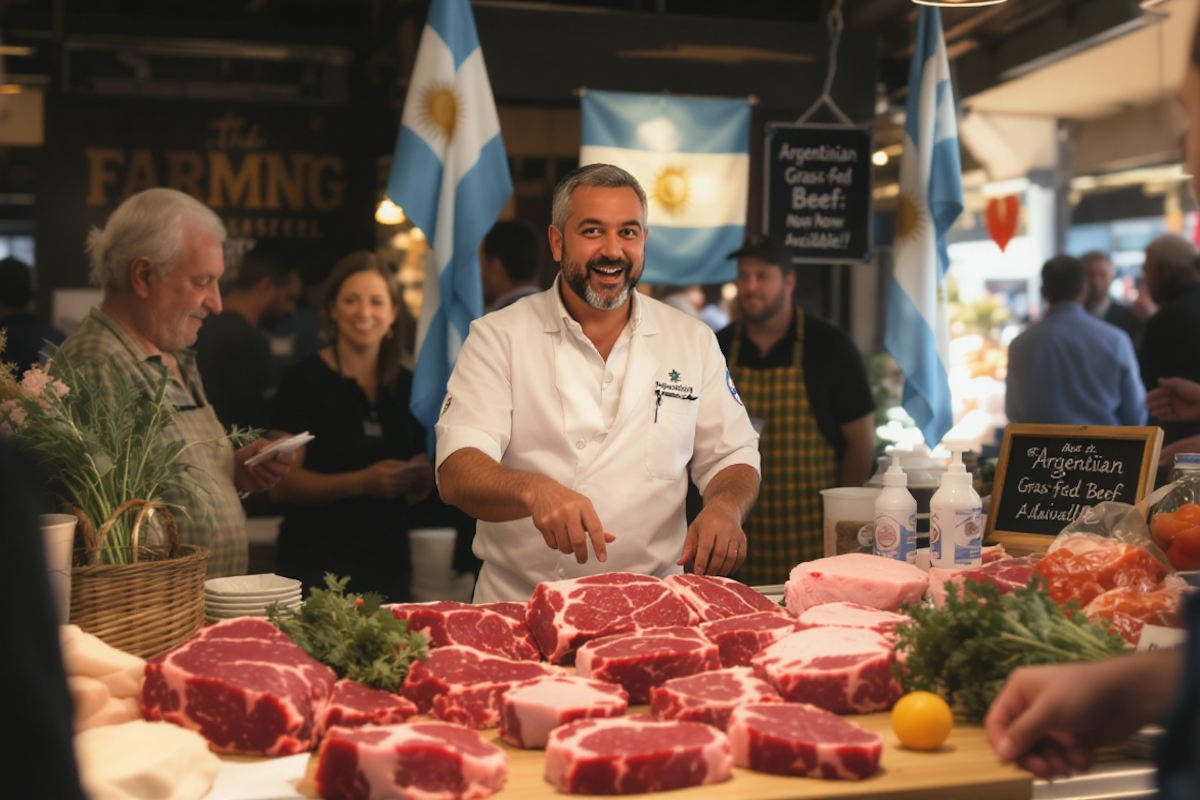
The United States quadrupled the preferential-tariff quota for beef imports from Argentina. To capture this wave (especially with grass-fed beef), digital traceability is the new passport to the world’s most demanding market.
What changed and why it matters
The U.S. government quadrupled the import quota with preferential tariffs for Argentine beef, raising it to 80,000 tons per year. The measure aims to ease domestic prices and secure supply in a market with sustained demand. For Argentina, this opens an unprecedented commercial window to place cuts and products with differential attributes such as grass-fed.
Beyond the quota increase, public discussion in the U.S. confirms that scrutiny will rise: imports are expected to meet strict standards of quality, sanitation and verification of label attributes.
The natural advantage of Argentine “grass-fed”
Pasture-based cattle ranching in Argentina offers a nutritional and environmental profile valued by U.S. consumers: animals raised in pasture systems, lower input intensity and an authentic origin story. In this context, positioning “Argentine grass-fed” with verifiable evidence is key to reaching better customers and prices.
The unavoidable requirement: end-to-end traceability for label claims
To enter and compete, having the attribute is not enough: you have to prove it. USDA/FSIS requires verifiable documentation to support animal raising and diet claims on labels (for example, “grass-fed” or “pasture-raised”) according to its guidelines and regulatory criteria. In practice, this means systems capable of tracking origin, feeding, animal welfare and production practices across the entire chain.
How to turn the opportunity into business: traceability as a commercial lever
Direct benefits of implementing digital traceability today:
- Faster access to importers and retailers that require audited evidence (USDA/FSIS).
- Substantiated label claims (grass-fed, pasture-raised), reducing friction in approvals.
- Brand differentiation in a market sensitive to quality, origin and sustainability.
- Immediate response to regulatory or customer verifications (documentation and reports ready).
Darwin Evolution’s offering for exporters and meatpackers
Darwin Evolution is an All-in-One traceability platform designed for complex, regulated agroindustrial chains. We integrate data capture in the field, origins and processes, with audit-ready evidence.
Three modules, one solution:
- CAPTIA: mobile capture (online/offline) of production data: feeding, sanitation, animal welfare, movements and events.
- TRACIUM: immutable record of CTE/KDE (Critical Tracking Events / Key Data Elements) and automatic generation of documentation for audits and customers.
- FIDENTA: Digital Product Passport (QR) that substantiates claims such as grass-fed / pasture-raised with verifiable evidence, ready for U.S. importers and retailers.
Results for your operation:
- Simpler FSIS compliance: ordered, verifiable supporting documentation.
- Faster time-to-market with fewer label rejections.
- Commercial trust: end-to-end transparency to close contracts on better terms.
Practical checklist to export “grass-fed” to the U.S.
- Define the claim (e.g., grass-fed / pasture-raised) and its scope (herds, establishments, periods).
- Standardize capture of feeding, sanitation and animal welfare at the lot/animal level.
- Link CTE/KDE from field, slaughter and deboning into a single flow (batch-lot).
- Consolidate evidence in a FSIS-ready dossier (supporting records, certificates, signed logs).
- Activate the digital passport (QR) for importers/retailers with the claim’s supporting evidence.
Conclusion: the time is now
The expanded quota in the U.S. opens a window of opportunity for Argentine beef, especially grass-fed. Those who deploy end-to-end traceability and supporting documentation for label claims will be the ones who capitalize first and best on this new access.
Want to enter the U.S. with a solid, verifiable “grass-fed” claim?
Request a demo and discover how Darwin Evolution turns traceability into your competitive edge.
Key sources:
- Reuters: “Trump quadrupling Argentina beef tariff rate quota to 80,000 metric tons” (report on the expansion of the U.S. quota for Argentine beef). (Reuters)
- U.S. Customs and Border Protection: QB 25-201 2025 Beef bulletin, “All beef imports from Argentina … require an e-CERT certificate to qualify for the in-quota tariff rate.” (U.S. Customs and Border Protection)
- Food Safety and Inspection Service (FSIS) / United States Department of Agriculture (USDA): “Guideline on Substantiating Animal-Raising or Environment-Related Labeling Claims (FSIS-GD-2024-0006)”. (fsis.usda.gov)
- FSIS: “Labeling Guideline on Documentation Needed to Substantiate Animal-Raising Claims for Label Submission”. (fsis.usda.gov)
- FSIS: “Argentina, Import/export library: Fresh (chilled or frozen) beef imported from the Northern Argentina region …” (sanitary and import requirements for Argentine beef). (fsis.usda.gov)
- U.S. Customs and Border Protection: QB 24-201 2024 Beef bulletin, “All beef imports from Argentina … require an export certificate in order to qualify for the in-quota tariff rate.” (U.S. Customs and Border Protection)
- Nebraska Farm Bureau: “Beef Imports & TRQs” (data on beef import quotas from countries such as Argentina). (nefb.org)
- Hogan Lovells: “USDA publishes updated guideline on substantiating animal-raising or environment-related labeling claims” (informational article on the FSIS guideline update). (hoganlovells.com)